At the end of 2021, your portfolio holds about fifteen cryptos. Some have gone 10x in a few months, and you feel like you have cracked the code. Two years later, half of them have lost more than 90% of their value, three are no longer listed anywhere, and your simple Bitcoin position has held up better than everything else.
This is the story of many investors who discover the world of altcoins during a bull market. Altcoins account for the biggest gains in the crypto market, but also for most of its permanent losses. Before buying any, you need to understand what they really are and how to sort through them.
What Is an Altcoin?
The word altcoin is short for "alternative coin": it refers to any cryptocurrency other than Bitcoin. Ethereum, Solana, XRP, Dogecoin, and even stablecoins are therefore, strictly speaking, altcoins.
The term was born in 2011, two years after Bitcoin launched. Namecoin, launched in April 2011, is generally considered the first altcoin: a fork of Bitcoin's code designed to create a decentralized domain name system. A few months later, in October 2011, Charlie Lee launched Litecoin, pitched as "the silver to Bitcoin's gold" with faster blocks. These early altcoins largely reused Bitcoin's code and tweaked a few parameters.
Everything changed in 2015 with Ethereum, which introduced smart contracts and made it possible for anyone to create their own token with a few lines of code. Since then, the number of cryptos has exploded: data aggregators list tens of thousands, and some blockchains see thousands of new tokens created every day.
A useful nuance: technically, "coins" have their own blockchain (ETH, SOL), while "tokens" are issued on an existing blockchain (UNI on Ethereum, for example). In everyday language, both are called altcoins. To go further, read our article on the difference between a coin and a token.
The Main Types of Altcoins
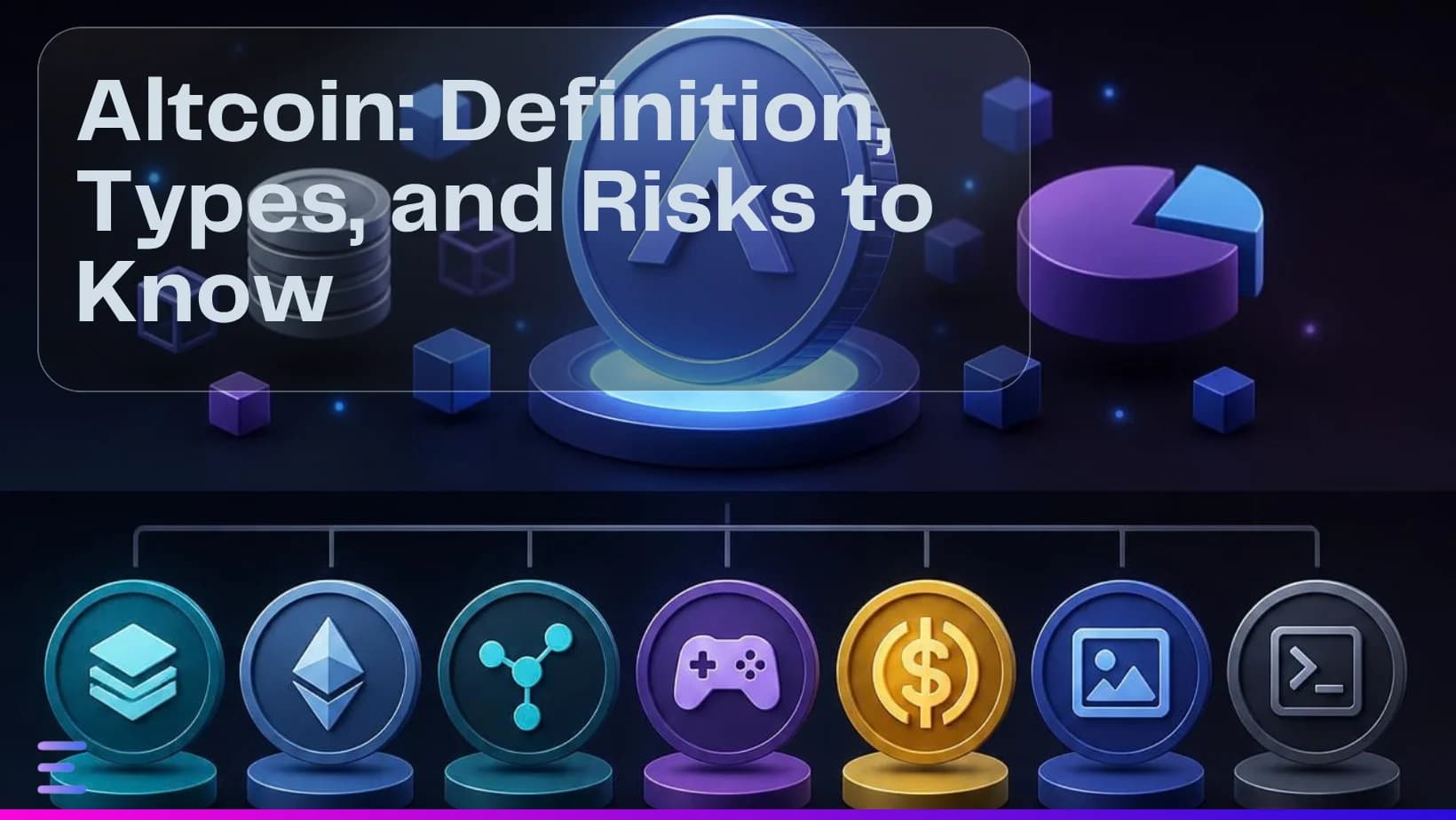
Not all altcoins play the same role, and their risks differ widely depending on their category.
Smart contract platforms. Ethereum, Solana, Avalanche, and Cardano are blockchains on which decentralized applications are built. Their token is used to pay transaction fees and, for Proof of Stake blockchains, to secure the network. These are generally the largest and most liquid altcoins.
Stablecoins. USDT, USDC, and DAI aim for a stable value, most often $1. They are altcoins in the technical sense, but their logic is the opposite: they do not try to gain value. We explain how they work in our guide to stablecoins.
Utility and governance tokens. They grant access to a service (storage, oracles, computing) or a vote on how a DeFi protocol evolves. UNI (Uniswap) and LINK (Chainlink) are examples. Their value depends on the real usage of the protocol and on how the token captures (or fails to capture) that value.
Memecoins. Dogecoin, created in 2013 as a joke, paved the way for thousands of tokens built around a meme or a community, with no claimed utility. Their price rests almost entirely on attention and speculation, which makes them the most volatile category.
Exchange tokens. BNB (Binance) and CRO (Crypto.com) are issued by trading platforms and offer fee discounts or other perks. Their value is closely tied to the health of the issuing company.
Privacy coins. Monero and Zcash strengthen transaction confidentiality. This feature exposes them to high regulatory risk: several exchanges have delisted them in certain countries.
Altseason and Bitcoin Dominance: How Altcoins Move
The term altseason describes a period during which altcoins clearly outperform Bitcoin. It usually happens in the late phase of a bull run: Bitcoin rises first, then gains rotate into Ethereum and large caps, and finally into smaller, more speculative altcoins.
The most watched indicator to spot this rotation is Bitcoin dominance, meaning Bitcoin's share of the total crypto market capitalization. When it falls sharply, capital is flowing into altcoins. In early 2018, for instance, dominance dropped below 40% at the peak of the ICO frenzy.
The problem is that altseasons are short and unpredictable. They often coincide with the end of a bull cycle. Investors who pile into altcoins at that point frequently buy at the worst price, just before a correction that hits altcoins far harder than Bitcoin.
Why Most Altcoins Underperform Bitcoin
Over a full cycle, a large majority of altcoins end up doing worse than Bitcoin, or disappear altogether. Just compare the rankings of the largest market caps from one cycle to the next: many names in the top 20 of 2017 or 2021 have slid far down the list.
Constantly growing supply. Many altcoins issue new tokens (rewards, unlocks for the team and private investors). This dilution puts steady selling pressure on the price, even when the project is making progress.
Endless competition. Creating a token costs almost nothing. Every innovation is quickly copied, and investor attention keeps shifting to the next narrative.
Fragile liquidity. In a bear market, buyers leave small projects first. Thinly traded altcoins can fall 80% to 95% and never recover their highs.
Projects that simply fail. Teams that walk away, no users, hacks, fraud: the reasons are many, and we analyze them in our article on why most crypto projects fail.
How to Evaluate an Altcoin Before Investing
No criterion guarantees an altcoin's success, but a few checks help you avoid many of the traps.
Look at market cap, not price. A token at $0.01 is not "cheap": what matters is the total value of the project. As we explain in market cap vs unit price, a very low-priced token can be worth billions.
Compare market cap and FDV. Fully Diluted Valuation estimates what the project would be worth if all planned tokens were in circulation. A large gap between the two signals heavy dilution ahead. Our article on FDV and its traps covers this in detail.
Check liquidity and volume. An altcoin listed on several major platforms, with steady daily volume, will let you exit when you want. A token traded on a single minor exchange is a potential trap.
Analyze the tokenomics. Who holds the tokens? What is the unlock schedule? Does the token have real utility within the protocol, or does it exist only for speculation?
Assess the team and usage. An identifiable team, open-source code, active users, and measurable revenue are worth far more than an ambitious roadmap and a loud community on social media.
How Much Room to Give Altcoins in a Portfolio
Altcoins can have a place in a crypto portfolio, as long as you size them according to their risk. A common approach is to keep a core in Bitcoin, possibly complemented by Ethereum, and to reserve a smaller share for altcoins, with even smaller positions in the tiniest and most speculative projects.
The key rule: never put an amount into a small altcoin that you could not afford to see go to zero. Setting profit-taking targets in advance also helps, because altcoins can lose in a few weeks what they gained over several months. Tracking the real allocation of your positions in a tool like Exceefy helps you notice when an altcoin has grown to an outsized share of your portfolio.
FAQ
Is Ethereum an altcoin?
Yes, strictly speaking: any crypto other than Bitcoin is an altcoin. In practice, many investors treat Ethereum separately because of its size, liquidity, and central role in the ecosystem. People sometimes use "altcoins" to mean everything that is neither Bitcoin nor Ethereum.
How many altcoins are there?
There is no exact figure. Major data aggregators list tens of thousands of cryptos, and millions of tokens have been created on some blockchains, notably through memecoin launch platforms. Only a small fraction has meaningful liquidity and activity.
How can you tell if altseason has started?
There is no 100% reliable signal. The most watched indicators are a rapid decline in Bitcoin dominance, outperformance of the ETH/BTC ratio, and a broad rally in small caps. But these signals often appear late, when the cycle is already well advanced.
Could an altcoin replace Bitcoin?
Nothing rules it out in theory, but since its creation Bitcoin has remained the largest crypto by market cap, with the strongest network effect, liquidity, and recognition. The most solid altcoins usually target other use cases (smart contracts, payments, DeFi) rather than competing directly with Bitcoin as a store of value.