"This token is at $0.003, if it goes to $1 I make 300x!" You've heard this reasoning before. Maybe you've even done it yourself. It's one of the most widespread errors in crypto and probably the one that costs beginners the most.
A token's unit price, in isolation, provides zero information about its valuation, upside potential, or whether it's "expensive." Zero. It's the market cap that matters.
The "Cheap Token" Illusion
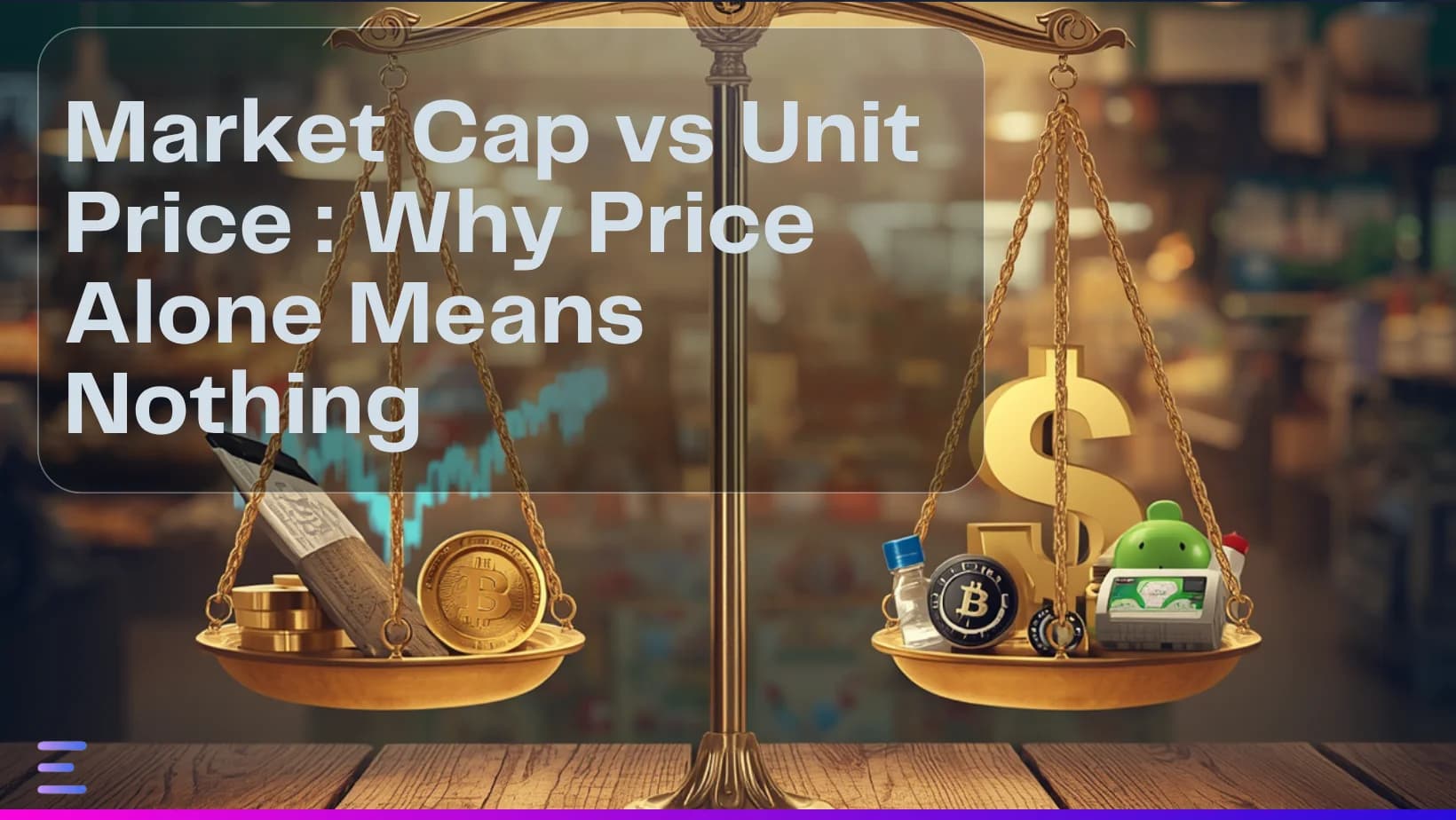
The reasoning is instinctive: a token at $0.001 seems "cheap" and a token at $60,000 (Bitcoin) seems "too expensive." But this impression is an illusion created by unit price without context.
A concrete example. Token A costs $0.001 and has 1 trillion units in circulation. Its market cap is $1 billion. Token B costs $500 and has 1 million units. Its market cap is $500 million. Token A is actually twice as "expensive" as Token B in total valuation terms, despite a unit price 500,000 times lower.
The error comes from anchoring bias: our brain instinctively compares a token's price to familiar references (a coffee, Bitcoin's price) instead of relating it to circulating supply. This bias pushes thousands of beginners to buy very low unit price tokens thinking they're "cheap," when their market cap shows they're sometimes already valued at billions.
Why a $0.001 Token Probably Won't Reach $1
When someone hopes a token goes from $0.001 to $1 (a 1000x), you need to translate that into market cap to evaluate the prediction's realism.
If the token has a circulating supply of 500 billion units, a price of $0.001 corresponds to a $500 million market cap. A price of $1 would correspond to a $500 billion market cap roughly half of the entire crypto market's total capitalization.
For a single altcoin to reach $500 billion capitalization, that project would need to become one of the world's largest digital assets, surpassing Ethereum. Is it impossible? No. Is it likely for a random token you found on Twitter? Extremely unlikely.
The calculation takes 10 seconds: target price × circulating supply = target market cap. If the target market cap is unrealistic, the price target is too regardless of how "low" the current unit price looks.
How to Evaluate Whether a Crypto Is "Expensive" or "Cheap"
Unit price doesn't allow this evaluation. Market cap gives a first framework but isn't enough either. Here are the real questions to ask.
Compare market cap to similar projects. If a DeFi protocol has a $2 billion market cap and its direct competitor (comparable features, comparable adoption) has a $500 million market cap, the gap merits investigation. Is it justified? That's the right question.
Look at the market cap / revenue ratio. Some crypto protocols generate real revenue (transaction fees, protocol revenue). The market cap / annual revenue ratio is crypto's equivalent of the P/E ratio in stocks. A very high ratio may indicate overvaluation; a low ratio may indicate an opportunity.
Evaluate market cap relative to real adoption. Active users, on-chain transaction volume, TVL for DeFi protocols these real usage metrics help evaluate whether a market cap is justified by network activity.
Factor in FDV. As we've covered, market cap alone can be misleading if a large portion of supply isn't yet circulating. FDV gives a more complete picture of the implied valuation.
The Golden Rule: Think in Market Cap, Not Price
Every time you evaluate a cryptocurrency, force yourself to reason in market cap, not unit price. Unit price is an artifact of circulating supply it can be as small or as large as the token's creators want, without changing anything about the project's real valuation.
A token can technically be worth $0.0000001 and be overvalued. Another can be worth $100,000 and be undervalued. Unit price tells you nothing. Market cap gives you a starting point.
FAQ
Is Bitcoin at $60,000 "too expensive" to buy?
No, Bitcoin's unit price is not an indicator of expensiveness. Bitcoin is divisible to 8 decimal places (1 satoshi = 0.00000001 BTC). You can buy $50 worth of Bitcoin. The relevant question isn't "is $60,000 expensive?" but "is Bitcoin's current market cap (over $1.2 trillion) justified by its fundamentals and adoption?" That's a valuation question, not a unit price question.
Why do projects create tokens with very low unit prices?
Because a low unit price psychologically attracts beginner investors who confuse low price with "bargain." A project can choose to issue 100 billion tokens instead of 100 million this doesn't affect the project's valuation but makes the unit price 1,000 times lower, which feels more accessible. It's a marketing choice, not a fundamental one.
Is there a tool to quickly calculate potential market cap?
Yes. The formula is simple: target price × circulating supply = target market cap. Most online market cap calculators (on CoinGecko, CoinMarketCap, or dedicated sites like thecoinperspective.com) let you enter a target price and see the corresponding market cap, as well as compare that valuation to other projects.