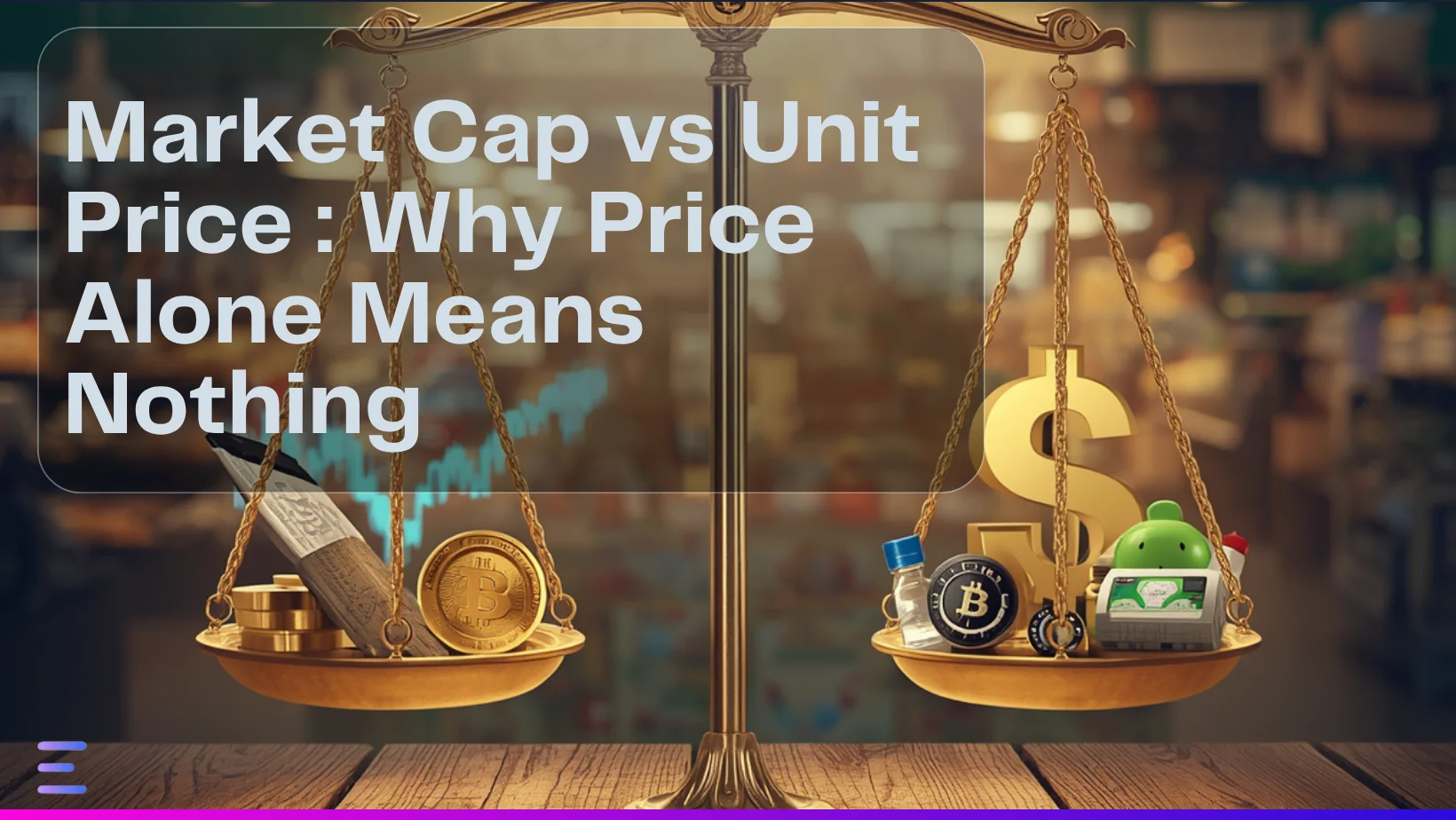
Why is Bitcoin worth tens of thousands of dollars per unit while XRP is worth less than a dollar? It's not because Bitcoin is "better" or XRP "worse." It's primarily a circulating supply question: Bitcoin has about 19.8 million units in circulation, while XRP has over 57 billion.
Circulating supply is one of the most important concepts to master for correctly evaluating a cryptocurrency's price and valuation. Without this understanding, you risk drawing wrong conclusions when comparing different tokens' unit prices.
What Is Circulating Supply?
Circulating supply refers to the total number of tokens or coins of a cryptocurrency currently available on the market and tradeable. It's the number used to calculate market cap: unit price × circulating supply = market cap.
It's important to distinguish circulating supply from two other often-confused metrics. Total supply includes all tokens that exist, including those locked, vesting, or not yet distributed but already created. Maximum supply is the maximum number of tokens that will ever exist the absolute ceiling defined by the protocol.
For Bitcoin, circulating supply is approximately 19.8 million, total supply is identical, and max supply is 21 million. For a recently launched token, circulating supply may represent only 10-20% of the planned total supply the rest being progressively released through vesting, staking, or programmed inflation.
How Circulating Supply Influences Price
The relationship between circulating supply and price follows a fundamental economic principle: at constant demand, the lower the supply, the higher the unit price. And vice versa.
That's why comparing two cryptocurrencies' unit prices without considering their circulating supply is meaningless. A token at $0.50 with 100 billion units in circulation has a $50 billion market cap it's a massive project. A token at $500 with 1 million units has a $500 million market cap it's a much smaller project. Unit price says nothing about project size or valuation.
Increasing circulating supply (through new token issuance) exerts downward price pressure, all else being equal. This is the inflation mechanism. If a protocol issues 10% additional tokens annually without proportional demand growth, the unit price will tend to fall 10% to maintain the same market cap.
Reducing circulating supply (through token burns or lock-ups) exerts upward pressure. This is the deflationary mechanism. Ethereum, with its EIP-1559 burn mechanism, destroys a portion of transaction fees, progressively reducing circulating supply and creating structural upward price pressure.
Events That Change Circulating Supply
Several events can significantly modify a token's circulating supply, and therefore impact its price.
Token unlocks are the most predictable. When founding teams, early-stage investors, or partners have their tokens unlocked after a vesting period, circulating supply suddenly increases. These events are pre-scheduled and trackable on specialized sites. A major unlock (representing more than 5% of circulating supply) often creates temporary selling pressure.
Bitcoin's halving halves the miner reward, slowing the rate of circulating supply increase. This event, occurring approximately every 4 years, has historically preceded significant bullish phases.
Burn mechanisms permanently destroy tokens, reducing both total and circulating supply. Some protocols (BNB, Ethereum) regularly burn tokens based on network activity.
Staking and lock-ups temporarily remove tokens from active circulation. When a significant proportion of supply is staked, the supply actually available for trading decreases, which can support the price.
Analyzing Circulating Supply Before Investing
Before investing in a token, three supply-related checks are essential.
Check what percentage of max supply is already circulating. If only 15% of tokens are in circulation and the remaining 85% will be released over coming years, you face massive dilution that will exert continuous downward price pressure.
Review the vesting schedule. Identify major unlock dates and evaluate their potential impact. A 20% circulating supply unlock in a single event can have a devastating effect on price if unlocked holders decide to sell.
Evaluate the annual inflation rate. Calculate how many new tokens are issued each year as a percentage of circulating supply. An inflation rate above 10-15% per year is aggressive and requires proportional demand growth to maintain the price.
FAQ
Why do some cryptos have very high circulating supply?
Each project defines its tokenomics based on its needs. Projects designed for micro-payments (XRP, DOGE) intentionally have high supply to maintain a low unit price and facilitate small transactions. Projects designed as store of value (Bitcoin) have limited supply to create scarcity. The absolute number of circulating tokens is a design choice, not a quality indicator.
Is circulating supply always accurate on aggregators?
Not always. Circulating supply data on CoinGecko or CoinMarketCap are estimates based on available information. They can be inaccurate if the project doesn't update its data, if tokens are lost in inaccessible wallets, or if counting methodology differs. For major projects, this data is generally reliable. For smaller projects, always verify directly on the blockchain.
Is a deflationary token always a good investment?
No. Deflation (supply reduction) creates upward price pressure, but it doesn't guarantee the price will rise. If demand for a token decreases faster than its supply, the price will fall despite the deflationary mechanism. Deflation is a positive factor to integrate into analysis, but it doesn't replace solid fundamentals.