
A vulnerability affecting the Ethereum app on Ledger hardware wallets was recently patched. The case, made public by Charles Guillemet, Ledger's CTO, illustrates several structural dynamics currently reshaping crypto cybersecurity: the rise of AI-assisted vulnerability research, the persistent failures of responsible disclosure, and the fragility of security information in an environment where attention is monetised.
This article offers a technical and strategic reading of the case. It goes beyond a simple security bulletin to analyse what the episode reveals about the balance of power in security research applied to digital assets, and provides an update procedure for affected users.
 Ledger logo — Ledger Corporate, CC BY-SA 4.0 via Wikimedia Commons, recoloured on a dark background.
Timeline and technical context
The discovery by Ledger Donjon
Ledger Donjon, Ledger's in-house offensive security research team, identified a vulnerability affecting certain clear signing processes in the Ethereum app installed on Ledger devices. Clear signing is the process by which the user sees and validates, on the device's physical screen, the exact parameters of a transaction before it is cryptographically signed.
 Exploded view of a Ledger Flex: the secure screen that displays transaction parameters, and the electronics around it. Ledger visual.
According to Charles Guillemet's official communication, the discovery was made using in-house AI-based vulnerability research tooling. That detail is not incidental: it reflects a major shift in security research methodology, where traditional fuzzing techniques are augmented by models capable of exploring attack surfaces far more efficiently.
The patch
A fix was developed and shipped through an Ethereum app update roughly two weeks ago. Users running an up-to-date firmware and Ethereum app have therefore been protected since then.
No active exploitation of the vulnerability has been reported, and the exposure window is limited by construction, since the discovery was made internally and the patch was deployed quickly.
The controversy
 Charles Guillemet, Ledger's CTO, publicly called out the responsible disclosure failures in this case. Ledger photo.
After the patch was deployed, an external company presenting itself as a "smart contract security" specialist published a public communication implying the existence of an unpatched vulnerability in Ledger signers.
According to Ledger's CTO, that company contacted Ledger's bug bounty programme after publishing its analysis, without prior engagement with the bounty team, and without following the principle of coordinated disclosure.
This sequence raises two distinct problems that are worth examining separately.
Issue 1: AI-assisted vulnerability research
A methodological shift
Using artificial intelligence tooling for vulnerability research marks a major technical turning point. Traditional approaches combined manual code review, fuzzing with algorithmically generated inputs, and static/dynamic analysis via tools such as AFL, LibFuzzer or KLEE.
New AI-assisted approaches enable:
- Semantically guided exploration of execution paths, prioritising the branches most likely to contain bugs based on learned patterns.
- Adversarial input generation specifically targeting fragile assumptions in the code, particularly around serialisation and type conversions.
- Cross-component analysis capable of detecting vulnerabilities that emerge from the interaction between several modules, often invisible to traditional tools focused on a single unit of code.
For the actors who master these techniques, the advantage is asymmetric: where traditional research required weeks of expert work, AI tooling can explore equivalent attack surfaces in hours or days.
The defender/attacker asymmetry
This methodological shift benefits defenders and attackers alike. Security teams such as Ledger Donjon can identify and fix vulnerabilities before they are exploited. But malicious actors have access, in principle, to the same tools, applied to offensive rather than defensive research.
In that context, patching speed becomes a survival criterion. A delay of several months between discovery and patch, once acceptable, now exposes users to a genuine risk of exploitation by attackers using the same AI tooling.
That is precisely why Ledger Donjon adopted these tools: internal AI-assisted offensive research is the only way to maintain an edge over attackers in the long run.
Issue 2: the responsible disclosure crisis
The established protocol
Responsible (or coordinated) disclosure is a methodological framework consolidated since the 2000s, formalised notably in the ISO/IEC 29147 standard and adopted by virtually every serious cybersecurity actor.
The principle is simple: a researcher who identifies a vulnerability contacts the vendor of the affected product confidentially, gives them a reasonable window (typically 30 to 90 days) to develop and ship a fix, and only publishes their technical findings once that window has closed.
The framework serves two cumulative goals:
Protecting users. Publishing a vulnerability before a fix is available exposes users directly to attacks.
Recognising the researcher's contribution. The vendor publicly credits the researcher at the time of the fix, often with a monetary reward through a bug bounty programme. This model is what made security research economically viable.
The deviation observed
According to Charles Guillemet's communication, the third-party company involved in the Ledger case bypassed that protocol:
- Publication of an analysis suggesting the existence of an active vulnerability.
- Subsequent contact with Ledger's bug bounty programme, without prior engagement.
- No verification that the vulnerability was still exploitable at the time of publication.
This sequence raises several methodological questions. Publishing without checking whether a fix has already been deployed is, in itself, a failure of the rigour expected from an actor presenting itself as a security specialist. Suggesting an active vulnerability when it has already been patched may reflect technical incompetence or a deliberate communication strategy.
Attention monetisation as a perverse incentive
Since 2020, the crypto ecosystem has developed an attention economy in which social media visibility (particularly on X and Farcaster) translates directly into value capture: fundraising, advisory contracts, token listings, and so on.
In that context, publishing an alarming vulnerability analysis about a major player like Ledger mechanically produces a spike in attention, regardless of how accurate or current the information is. The reputational cost of a mistaken publication is low, while the marketing gain is immediate.
This economy creates a structural incentive to bypass responsible disclosure in favour of pre-emptive public communication. That is precisely what Charles Guillemet denounces as FUD (Fear, Uncertainty and Doubt): manipulating security uncertainty to generate attention.
Issue 3: the cost to the ecosystem
Erosion of trust
Every publication of an alleged vulnerability in a major hardware wallet erodes general user confidence in the security of their assets. That erosion is not easily quantifiable, but it produces several measurable effects:
- A retreat from self-custody in favour of keeping funds on centralised platforms, which carry far greater but less publicised risks.
- A multiplication of rushed transfers between wallets, which expose users to operational mistakes (wrong network, "address poisoning" scams).
- The development of a fatalistic attitude towards security that discourages good practice (updating, verifying signatures, and so on).
The difficulty of assessing source reliability
For a non-technical user, distinguishing a genuine vulnerability from opportunistic communication is extremely difficult. The technical vocabulary is similar, the tone of urgency is identical, and every source claims security expertise.
That difficulty creates room for bad-faith actors, whether they are companies chasing visibility or outright malicious attackers who exploit the climate of anxiety to circulate fraudulent instructions (fake "securing" procedures, fake Ledger Live, phishing).
Ledger update procedure
Setting the strategic considerations aside, the immediate operational recommendation is simple: keep your Ledger firmware and apps up to date. Here is the detailed procedure.
Vendor source: this procedure follows the recommendations in the official Ledger guide published on support.ledger.com.
Prerequisites
- Ledger Nano S Plus, Nano X or Ledger Stax
- The supplied USB cable (or a Bluetooth connection for the Nano X)
- Ledger Live installed from the official source: https://www.ledger.com/ledger-live
- The device PIN code
Checking the firmware version
- Open Ledger Live and connect the device.
- Enter the PIN code to unlock the Ledger.
- In the left-hand menu, click My Ledger.
- The installed firmware version is displayed at the top of the section.
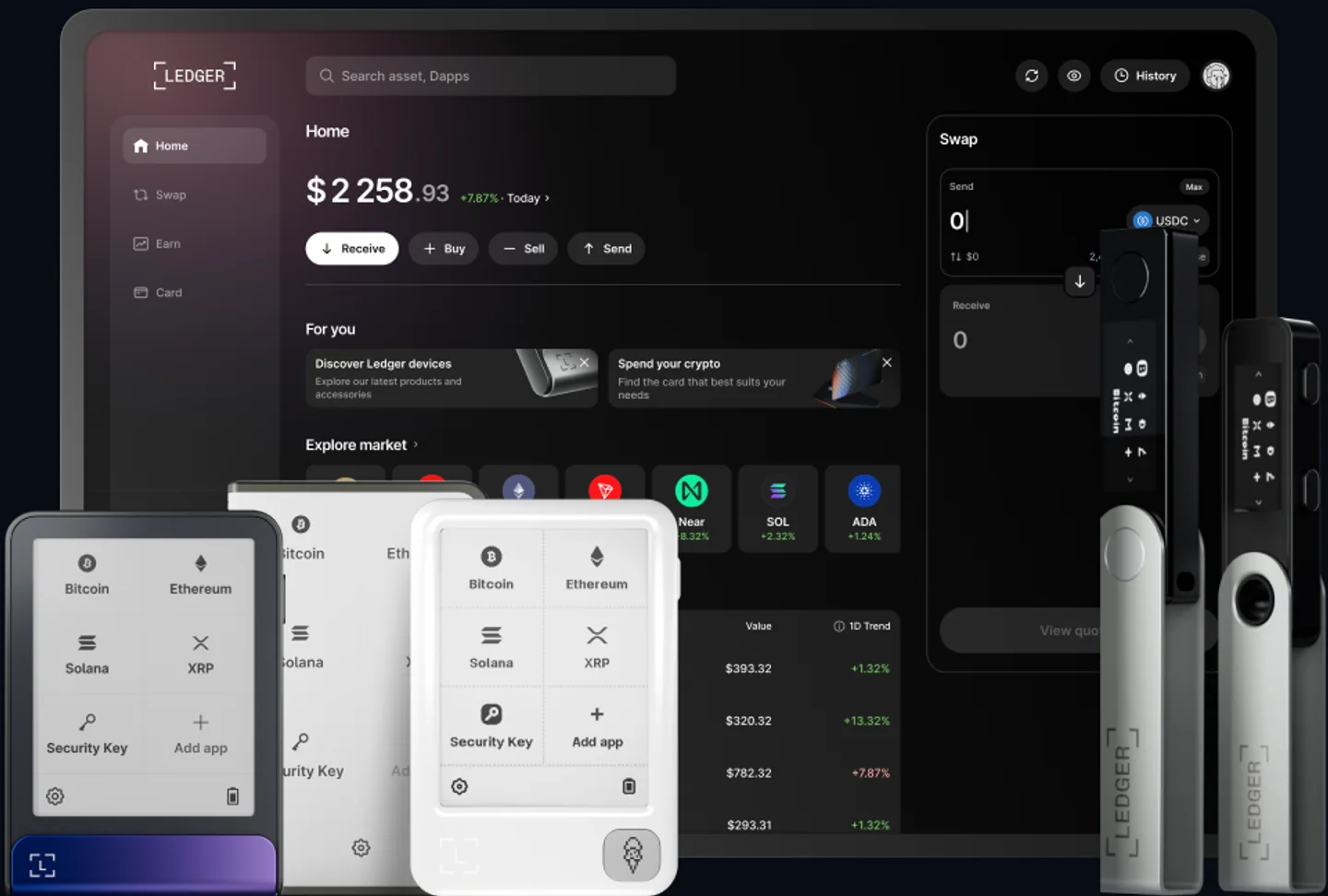 The Ledger desktop app, where version checks and updates are performed. Ledger visual.
Versions considered up to date at the time of publication:
- Ledger Nano S Plus: firmware 1.1.x or higher
- Ledger Nano X: firmware 2.4.x or higher
- Ledger Stax: firmware 1.4.x or higher
If an update is available, an Update button is displayed.
Updating the firmware
- Click Update.
- Follow the on-screen instructions, including the confirmations to validate on the Ledger's physical screen.
- Do not disconnect the Ledger during the procedure.
- Wait for the update to complete (5 to 10 minutes).
Critical check. No legitimate update procedure ever asks you to enter your 24-word recovery phrase. If any screen (in Ledger Live or on the device) makes that request, you are dealing with a compromise (fake Ledger Live, malware). Stop the procedure immediately.
Updating the apps
- After the firmware update, go back to My Ledger.
- Scroll down to the Installed apps section.
- Each app with an available update displays an Update button.
- Click it for each app, starting with Ethereum in the context of this particular vulnerability.
 The grid of apps installed on the device, with the "Add app" entry. Ledger visual.
Final verification
Go back to My Ledger and check:
- Firmware up to date (latest version displayed)
- No app showing an available update
- Accounts accessible as usual in the Accounts section
General recommendations
This case illustrates several security management principles for individual users and companies alike.
Automate update monitoring. Do not rely on reading public announcements to learn about fixes. Checking Ledger Live periodically (monthly at minimum) is a basic reflex.
Establish identified sources of trust. In the event of a security alert, refer directly to the vendor's official channels (blog, CTO communication, status page) rather than to social relays. The X account of Charles Guillemet, Ledger's CTO, is a reliable primary source.
Never share your recovery phrase. This absolute principle must be internalised for good. No legitimate situation ever justifies sharing that information.
Verify before signing. Clear signing displays the exact parameters of a transaction on the Ledger's screen. That visual check remains the last line of defence against malware that would alter transactions at the software interface level.
Diversify your alert channels. Following several independent crypto security sources (Ledger Donjon, Trail of Bits, ChainSecurity, OpenZeppelin) makes it possible to cross-check information and spot dubious communications.
Conclusion
Strictly on technical grounds, the Ledger Ethereum vulnerability patched in August 2026 is a favourable case: internal discovery, fast fix, no active exploitation. It illustrates the benefits of integrating AI tooling into defensive research.
On security communication, however, the case reveals a worrying divide between actors who practise responsible disclosure and those who favour pre-emptive public communication. That divide is not specific to Ledger or to the crypto sector, but it is particularly acute in an ecosystem where attention is monetised and end users are exposed to direct financial risk.
For users, the practical answer is robust: keep systems up to date, rely on reliable primary sources, ignore unverified alerts. For the ecosystem, the challenge is to restore the value of coordinated disclosure against the temptation of immediate visibility.
Resources and useful links
- Official Ledger guide: updating firmware and apps: https://support.ledger.com/article/8169264853789-zd
- Download Ledger Live (official source): https://www.ledger.com/ledger-live
- Ledger Donjon (offensive security research): https://donjon.ledger.com
- ISO/IEC 29147 standard (vulnerability disclosure): available from ISO
- Ledger bug bounty programme: https://donjon.ledger.com/bounty
FAQ
What is clear signing on a Ledger?
Clear signing is the process by which the user reviews, on the Ledger's physical screen, the exact details of a transaction (destination address, amount, network, contract data) before authorising its cryptographic signature. It protects against malware that alters transactions at the software interface level.
Why does AI-assisted research change the security landscape?
AI makes it possible to explore complex attack surfaces faster and more efficiently, prioritising suspicious execution paths and generating relevant adversarial inputs. That acceleration benefits defenders but also, potentially, attackers, which imposes a faster patching cadence.
What is responsible disclosure?
It is the protocol whereby a security researcher confidentially contacts the vendor of a product affected by a vulnerability, allows a reasonable window for a fix to be developed, and only publishes their findings once that fix has shipped. The protocol exists to protect end users.
How can you tell a genuine security alert from FUD?
Check the source (an official vendor channel or a recognised third party), the timing (is a fix already available?), and the nature of the request (a genuine alert never asks you to transfer funds to an address or to share a recovery phrase). When in doubt, wait for confirmation from a primary source.
Should companies adapt how they manage Ledger devices?
Yes. Companies holding significant crypto assets should put in place a formal hardware wallet management policy covering: device inventory, a periodic update procedure, phishing awareness training, and subscription to official alert channels.