It's 11 p.m. on a Sunday and you want to swap some ETH for digital dollars, then lend those dollars out to earn interest. Your bank is closed, and it doesn't offer anything like that anyway. Yet in a few clicks from your wallet, without opening an account or showing any ID, the job is done. No advisor, no branch, just code running on a blockchain.
That is the promise of DeFi, decentralized finance. It's an attractive promise, but it comes with risks that many newcomers only discover too late. Here's how it really works, and how to approach it without getting burned.
What Is DeFi?
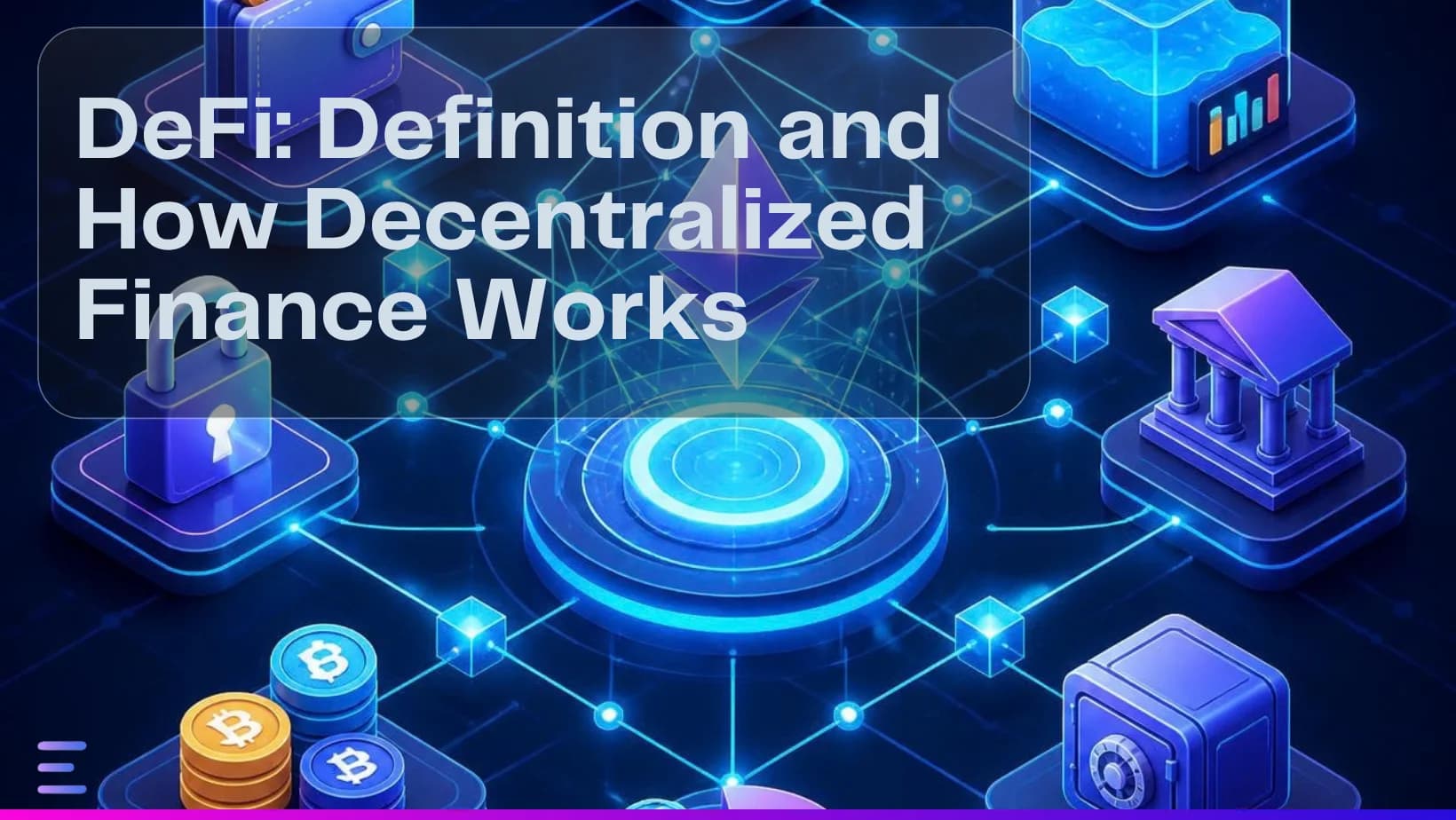
DeFi (short for Decentralized Finance) refers to all the financial services that run on smart contracts deployed on a public blockchain, with no central intermediary. Swapping assets, lending, borrowing, earning yield, or buying coverage: these operations, traditionally handled by banks, brokers, or stock exchanges, are executed automatically by open programs.
In practice, a DeFi protocol is a set of smart contracts whose rules are written in code and visible to everyone. When you deposit funds into a protocol, no company holds them: the contract itself does, following rules that nobody can change arbitrarily (except through governance mechanisms defined in advance).
Ethereum was the birthplace of DeFi around 2017 and 2018, with projects like MakerDAO and Uniswap. The movement truly took off in the summer of 2020, a period often called "DeFi Summer".
The Building Blocks of Decentralized Finance
DeFi isn't a single product but an ecosystem of building blocks that fit together. Here are the main ones.
DEXs and AMMs. A DEX (decentralized exchange) lets you swap tokens directly from your wallet. Most of them, like Uniswap, rely on an AMM (Automated Market Maker): instead of an order book, trades are made against liquidity pools funded by users. The price is set by a mathematical formula based on the quantities of each token in the pool.
Lending and borrowing. Protocols like Aave or Compound let you deposit crypto to earn interest, or borrow by posting collateral. One key feature: loans are overcollateralized. To borrow $1,000, you often need to deposit $1,300 to $1,500 of collateral or more. If the value of your collateral falls below a certain threshold, your position is automatically liquidated to repay the lender.
Stablecoins. They are the fuel of DeFi. A stablecoin such as USDC or DAI tracks the value of the dollar and serves as the unit of account for trades, loans, and yields. Without them, DeFi would be much harder to use, since everything would be denominated in volatile assets.
Liquid staking. Staking normally locks up your tokens. Liquid staking protocols such as Lido give you a receipt token in return (for example stETH) that you can use elsewhere in DeFi while still earning staking rewards.
Yield farming and liquidity provision. By depositing a pair of tokens into a DEX pool, you become a liquidity provider and earn a share of the trading fees. Yield farming means moving your funds between protocols to maximize these returns, often boosted by rewards paid in governance tokens.
DeFi vs CeFi: What Really Changes
CeFi (centralized finance) covers traditional crypto platforms: exchanges like Coinbase or Binance and centralized lending services. The difference with DeFi comes down to four points.
Self-custody. In DeFi, you keep control of your private keys. No platform can freeze your account or go bankrupt with your funds, as happened when FTX collapsed in 2022. The flip side: nobody can help you if you lose your keys or sign a bad transaction.
Transparency. Every transaction and every protocol balance is visible on-chain. You can check in real time how much a protocol holds, which is impossible with a centralized platform.
Composability. DeFi protocols stack like Lego bricks: a token received on one can immediately be used as collateral on another. Composability speeds up innovation, but it also creates chains of dependencies.
24/7, permissionless access. No opening hours, no borders, no identity checks at the protocol level. A wallet and an internet connection are enough.
How to Measure DeFi: TVL
The sector's benchmark metric is TVL (Total Value Locked), the total value of assets deposited in DeFi protocols. Aggregators like DefiLlama track it in real time, by protocol and by blockchain.
Global TVL peaked at roughly $170 to $180 billion in late 2021, before falling sharply during the 2022 bear market. It remains an imperfect metric, though: it depends directly on the price of the deposited crypto and can be inflated by double counting caused by composability. Use it as an order of magnitude, not as an absolute measure of adoption.
Where DeFi Lives Today
Ethereum has historically held most of the TVL and hosts the most established protocols (Uniswap, Aave, Maker, Lido). But high transaction fees on Ethereum have pushed part of the activity to other networks.
Layer 2 solutions like Arbitrum, Optimism, or Base let you use the same protocols with much lower fees while relying on Ethereum's security. Solana, for its part, has built a very active DeFi ecosystem driven by its speed. Other blockchains such as BNB Chain and Avalanche also host their own protocols.
This fragmentation gave rise to bridges, which move assets from one blockchain to another. They answer the need for interoperability, but they are among the weakest links in the ecosystem.
The Risks of DeFi
DeFi removes the intermediary, not the risk. It shifts that risk onto you.
Smart contract bugs and exploits. A poorly written contract can be exploited within minutes, and stolen funds are rarely recovered. Even audited protocols aren't immune: an audit reduces risk, it doesn't eliminate it.
Bridge hacks. Bridges hold huge amounts of value and are a favorite target for hackers. The Ronin bridge hack in 2022 (more than $600 million) remains one of the biggest crypto hacks in history.
Impermanent loss. When you provide liquidity on an AMM and the relative price of the two tokens diverges sharply, you can end up with less value than if you had simply held your tokens. The fees you earn don't always make up for this loss.
Liquidation. On a lending protocol, a sudden market drop can trigger the liquidation of your collateral, with a penalty on top. In periods of high volatility, this can happen within hours.
Oracle manipulation. Protocols rely on oracles to know asset prices. If an attacker manages to distort that data, for instance on an illiquid pool, they can drain a protocol.
Rug pulls. Some projects are created solely to collect funds before their creators vanish with the money. Abnormally high yields are often the first warning sign.
Regulatory risk. The legal framework for DeFi remains unclear in many countries. The European MiCA regulation covers service providers and stablecoins, but "fully decentralized" DeFi is for now largely outside its scope, which could change.
User experience and phishing. Signing a malicious transaction, approving a fraudulent contract, or connecting to a fake website is enough to lose your funds. In DeFi, a wrong click is often irreversible.
How to Approach DeFi Carefully as a Beginner
If you want to explore decentralized finance, a few simple rules limit the damage.
Start with an amount you can afford to lose entirely. Favor protocols that have been around for several years, with significant TVL and public audits. Be wary of double or triple digit yields: a high return always pays for a high risk, even when that risk isn't visible.
Use a wallet dedicated to DeFi, separate from the one holding your long-term savings. Always check website URLs, regularly revoke the permissions you've granted to contracts, and avoid borrowing until you fully understand how liquidation works. Finally, keep precise track of your positions: between deposits, receipt tokens, and rewards, a DeFi portfolio quickly becomes hard to read, and a tool like Exceefy helps you keep a clear view of the whole picture.
FAQ
Is DeFi legal?
In most countries, including France, using DeFi protocols is not prohibited. However, any gains remain subject to the tax rules on digital assets, and the tax treatment of some operations (lending, liquidity provision, rewards) can be complex. Keep a detailed history of your transactions.
Can you really lose all your money in DeFi?
Yes. A hack, a rug pull, a liquidation, or a fraudulent transaction signed by mistake can lead to a total loss. Unlike a bank, there is generally no deposit insurance and no customer service to reverse a transaction.
What's the difference between a DEX and a centralized exchange?
On a centralized exchange, you deposit your funds on the platform, which holds them and executes your orders in its order book. On a DEX, you trade directly from your wallet against a smart contract, without ever handing your funds to a third party. A DEX gives you more control, but leaves you solely responsible for your security.
Where does DeFi yield come from?
Yield mainly comes from interest paid by borrowers, trading fees paid to liquidity providers, staking rewards, and governance token emissions. That last type of yield is often the highest, but also the least sustainable, because it depends on the value of a newly created token.