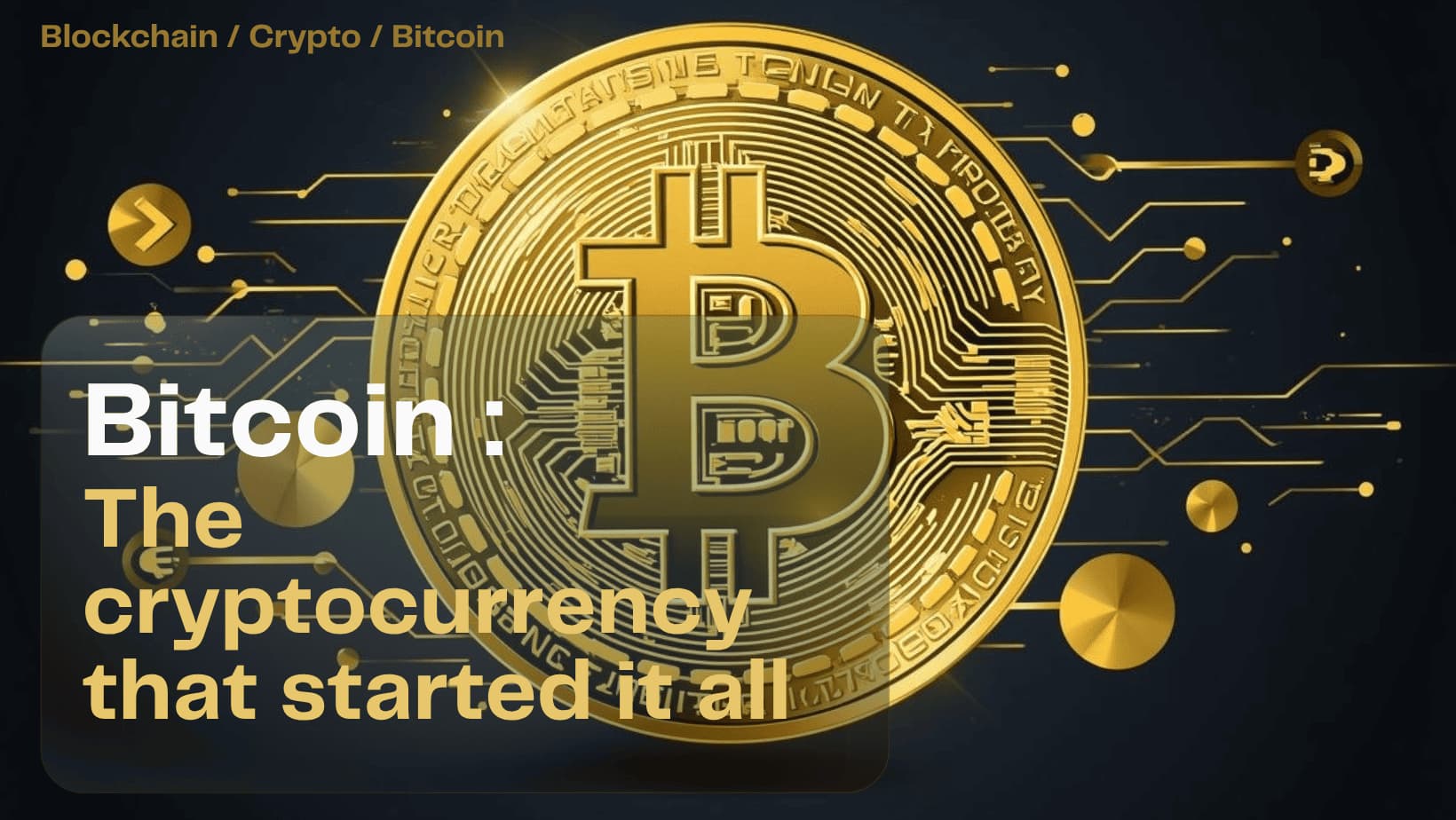
Bitcoin: The Cryptocurrency That Started It All
Bitcoin (BTC) is not just the first cryptocurrency it’s a financial and technological revolution. Created in 2009 by the mysterious Satoshi Nakamoto, it allows the exchange of value directly, quickly, and securely, without banks or intermediaries.
Built on blockchain technology, Bitcoin ensures transaction transparency and immutability while offering high cryptographic security. Today, it serves as a medium of exchange, a store of value, and an investment asset.
🔸 Origins: An Idea Born in 2008
It all started on October 31, 2008, with the publication of the white paper:
“Bitcoin: A Peer-to-Peer Electronic Cash System”
The document describes a peer-to-peer monetary system with no central authority. A few months later, on January 3, 2009, the first block the Genesis Block was mined, marking the birth of the Bitcoin network.
Initially, only a few enthusiasts were interested. By 2010, the first exchanges gave Bitcoin its market value: ➡️ In October 2009, 5,050 bitcoins were worth… $5. ➡️ By February 2011, Bitcoin reached parity with the US dollar.
🔸 How Bitcoin Works
Bitcoin runs on a distributed, open ledger: the blockchain. Each transaction is recorded immutably, ensuring:
- Decentralization: no single authority controls the network.
- Immutability: once confirmed, a transaction cannot be altered.
Thousands of computers (nodes) maintain the blockchain, providing security, transparency, and resilience.
🔸 Mining: The Heart of the Blockchain
Mining is the process of validating transactions and creating new BTC. Miners use computing power to solve complex cryptographic problems. In return, they receive newly minted bitcoins.
🪙 The reward halves every 210,000 blocks (~4 years): this is called the halving.
Today, mining has become a global industry, often located in regions with cheap electricity.
🔸 A Limited Supply: 21 Million BTC
Bitcoin is designed to be scarce: the protocol caps the supply at 21 million BTC. This scarcity, combined with growing demand, gives it the status of a digital store of value, often compared to gold.
💡 1 BTC is divisible into 100,000,000 satoshis, allowing even very small purchases.
🔸 Bitcoin: A Response to the 2008 Crisis
Bitcoin emerged in response to the 2008 financial crisis and the centralization of banks. Satoshi Nakamoto envisioned a system where:
- anyone could hold and transfer their own wealth,
- transactions are public and verifiable,
- money creation is predictable and limited.
The first mined block contains a symbolic message referencing a Times article criticizing the UK government’s bank bailouts.
🔸 Bitcoin Today: A Global Asset
Originally conceived as a payment method, Bitcoin has become an investment asset.
Advantages:
- fast and low-cost transfers,
- censorship resistance,
- global accessibility.
Limitations:
- high volatility,
- partial adoption in commerce,
- energy consumption from mining.
⚡ On October 6, 2025, Bitcoin reached $126,173.18, confirming its central role in digital finance.
🔸 Tokenomics: A Deflationary Model
| Element | Description |
|---|---|
| Total Supply | Maximum of 21 million BTC |
| Halving | Mining reward halves every ~4 years |
| Inflation | Approaches zero by 2140 |
| Distribution | Fully decentralized |
| Scarcity | Comparable to gold |
Bitcoin is programmed against inflation, with trust based on code rather than a central bank.
🔸 Innovations and Evolutions
Bitcoin evolves continuously. Key innovations include:
- Lightning Network ⚡: instant, nearly free payments.
- Taproot 🧩: improves privacy and efficiency.
- Institutional adoption 💼: ETFs and investment funds strengthen legitimacy.
Bitcoin has thus become more than a currency: a strategic global asset.
🔸 In Summary
Bitcoin is the digital revolution that changed finance. In just fifteen years, it went from an idea on a forum to a globally adopted asset, used by millions of investors, companies, and individuals.
Whether seen as a freedom tool or speculative investment, Bitcoin has redefined value and financial sovereignty.