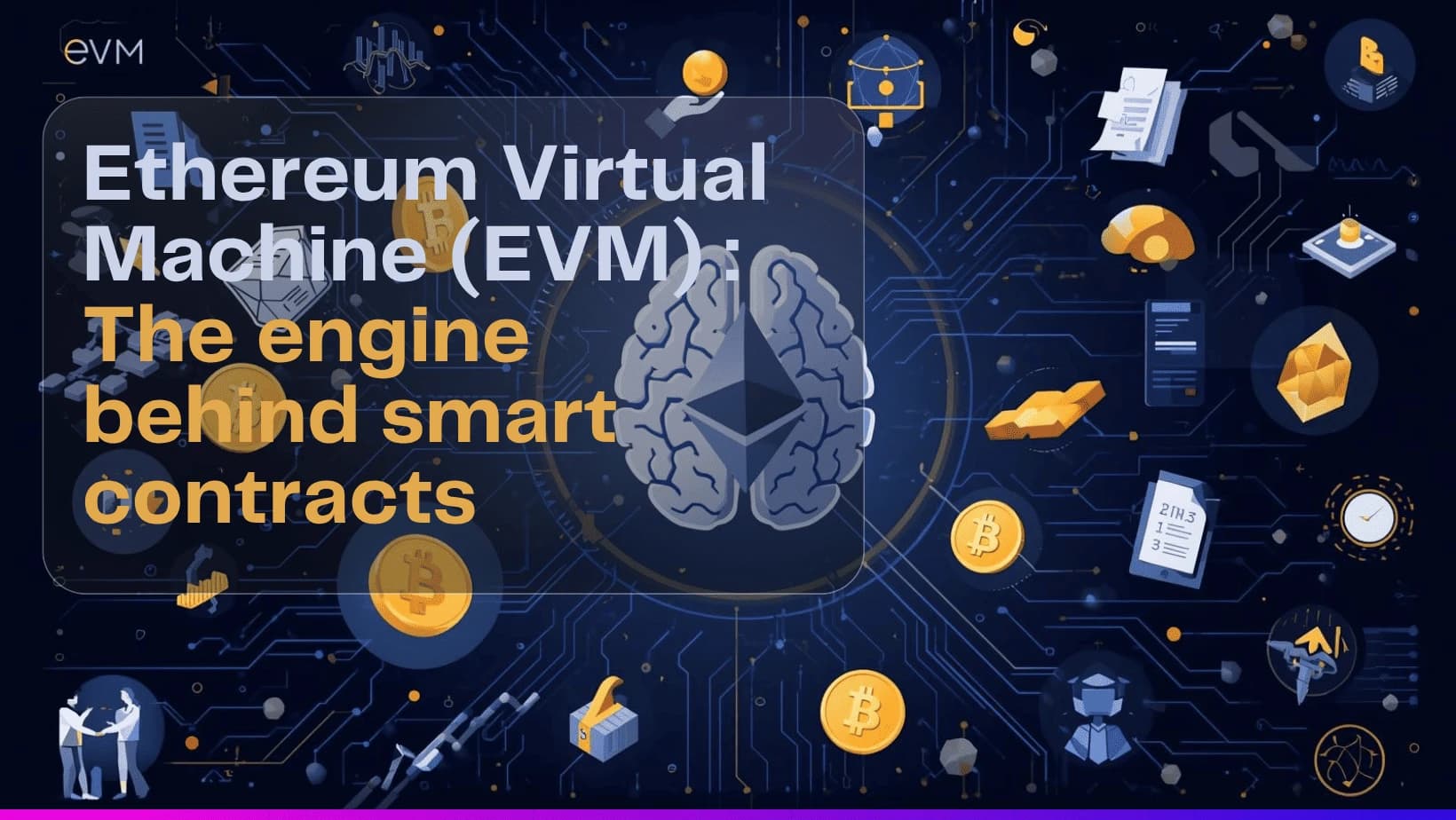
Ethereum Virtual Machine (EVM): The Engine Behind Smart Contracts
The Ethereum Virtual Machine (EVM) is the brain that runs smart contracts on Ethereum. It allows code to be executed decentrally, securely, and reliably, without relying on a central server.
And the EVM isn’t limited to Ethereum. It’s now used on blockchains like Polygon, Arbitrum, and Avalanche, where it plays a key role in the Web3 ecosystem.
What is the EVM?
The Ethereum Virtual Machine isn’t a physical computer: it’s a distributed system, replicated across thousands of nodes on the Ethereum network. Every node runs the same EVM version, ensuring that every transaction and every contract produces exactly the same result worldwide.
When a smart contract is deployed, the EVM ensures it runs faithfully according to Ethereum protocol rules. This is what provides trust, transparency, and consistency for the network.
How Does It Work?
The EVM acts as a state machine: with each block, it calculates the network’s new state based on previous transactions. Developers write smart contracts in Solidity, a language specifically designed for Ethereum.
This code is then compiled into bytecode, which the EVM reads and executes instruction by instruction, identically on every node. No matter who executes the code or from where, the final result is always the same.
This mechanism makes execution deterministic and therefore trustworthy.
Why Is It Essential?
Without the EVM, Ethereum as we know it wouldn’t exist. It keeps all nodes synchronized, ensuring network consensus.
More importantly, it enables the creation of decentralized applications (dApps): apps that run directly on the blockchain without intermediaries. Thanks to the EVM, entire sectors like DeFi, NFTs, and DAOs could emerge and thrive.
The EVM Beyond Ethereum
Today, the EVM has become a Web3 standard. Blockchains like Polygon, BNB Chain, Arbitrum, and Avalanche chose to be EVM-compatible, allowing developers to use the same code across multiple networks.
The result? Projects can be deployed on multiple blockchains without starting from scratch, enhancing interoperability and accelerating innovation.
And Tomorrow?
The EVM continues to evolve. It is now the common technical foundation for hundreds of blockchains and the preferred entry point for Web3 developers.
As more chains adopt this model, we move toward a more connected, seamless, and open ecosystem.
In short:
The EVM is the universal language of modern blockchains.